jumpToMain

Design and layout of bearing assembly bearing clearance, press fit

Theoretical bearing clearance

Bushes made from PERMAGLIDE® P1 and P2 are pressed into the housing and fixed in place radially and axially. No further measures are required. For rigid housings and shafts, the fitting tolerances from Table 1 result in the following:

  • The press fit
  • The bearing clearance as per Table 6


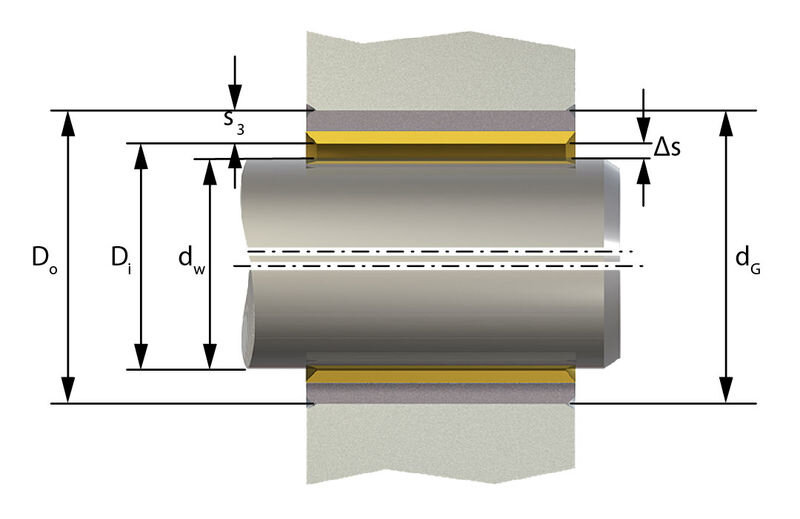
The theoretical bearing clearance is calculated as follows:

[12] Δsmax = dGmax – 2 · s3min – dWmin
[13] Δsmin = dGmin – 2 · s3max – dWmax

Δsmax [mm] Maximum bearing clearance
Δsmin [mm] Minimum bearing clearance
dGmax [mm] Maximum diameter of housing bore
dGmin [mm] Minimum diameter of housing bore
dWmax [mm] Maximum shaft diameter
dWmin [mm] Minimum shaft diameter
s3max [mm] Maximum wall thickness
s3min [mm] Minimum wall thickness (see Tab. 4)
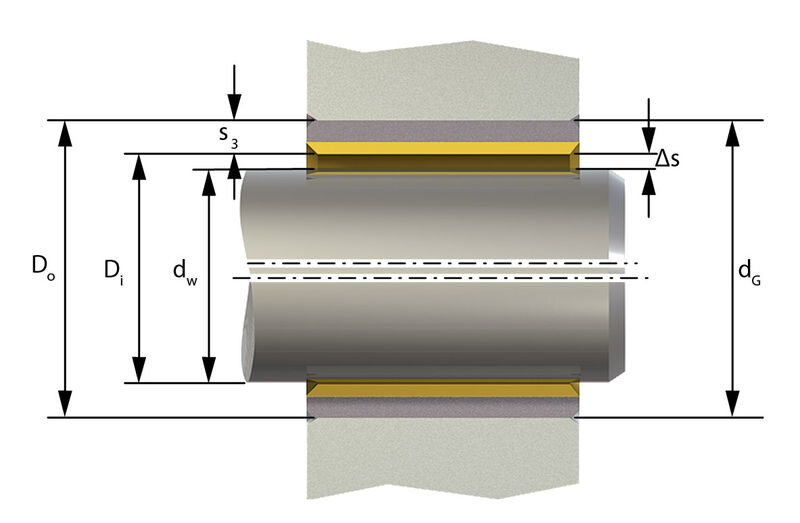
30073

Attention:

Widening the housing bore is not taken into consideration in the bearing clearance calculation.
For calculating the press-fit U, the tolerances of the housing bore are stated in Table 1 and the dimensions of the bush outside diameter DO are stated in Table 2.

Press fit and bearing clearance

The bearing clearance and press fit can be influenced by the measures shown in Tab. 7:
 
  • At high ambient temperatures
  • Depending on the housing material
  • Depending on the housing wall thickness.

Smaller clearance tolerances require narrower tolerances for the shaft and bore.

Attention:

When using shafts with tolerance zone position h, the bearing clearance for 5≤dW<80 (P10, P14, P147) and dW<80 (P 11) must be verified using equations [12] for Δsmax and [13] for Δsmin.
Tab. 1: Recommended fitting tolerances
Diameter range P10, P14, P147*, P180 P 11 P20, P200
Shaft      
dW <5 h6 f7 h8
5≤ dW <80 f7 f7 h8
80≤ dW h8 h8 h8
Housing bore      
dG ≤5.5 H6 - -
5.5< dG H7 H7 H7
Tab. 2 - Dimensions for outside diameter Do
Außendurchmesser
der Buchse Do
Abmaße (Prüfung A
nach DIN ISO 3547-2)
  P10, P14, P147*,
P20, P200, P180
  P 11    
  oberes unteres oberes unteres  
Do ≤ 10 +0.055 +0.025 +0.075 +0.045  
10 < Do ≤ 18 +0.065 +0.030 +0.080 +0.050  
18 < Do ≤ 30 +0.075 +0.035 +0.095 +0.055  
30 < Do ≤ 50 +0.085 +0.045 +0.110 +0.065  
50 < Do ≤ 80 +0.100 +0.055 +0.125 +0.075  
80 < Do ≤ 120 +0.120 +0.070 +0.140 +0.090  
120 < Do ≤ 180 +0.170 +0.100 +0.190 +0.120  
180 < Do ≤ 250 +0.210 +0.130 +0.230 +0.150  
250 < Do ≤ 305 +0.260 +0.170 +0.280 +0.190  
Tab. 3 - Wall thickness s3 for P1 bushes and flange bushes
Inside diameter
of bush D1
Wall
thickness s3
Dimensions to DIN ISO 3 547-1, Table 3, row B
    P10, P14, P147*, P180   P 11  
    Upper Lower Upper Lower
D1 ≤ 5 0.75 0 -0.020 - -
  1 - - +0.005 -0.020
5 ≤ D1 < 20 1 +0.005 -0.020 +0.005 -0.020
20 ≤ D1 < 28 1.5 +0.005 -0.025 +0.005 -0.025
28 ≤ D1 < 45 2 +0.005 -0.030 +0.005 -0.030
45 ≤ D1 < 80 2.5 +0.005 -0.040 +0.005 -0.040
80 ≤ D1 < 120 2.5 -0.010 -0.060 -0.010 -0.060
120 ≤ D1 2.5   -0.035 -0.085 -0.035 -0.085
Tab. 4 - Wall thickness s3 for bushes made from PERMAGLIDE® P20/P200
Inside diameter D1 Wall thickness Dimensions to DIN ISO 3 547-1, Table 3, row D, P20, P200
  s3 Upper Lower
8 ≤ Di < 20 1 -0.020 -0.045
20 ≤ Di < 28 1.5 -0.025 -0.055
28 ≤ Di < 45 2 -0.030 -0.065
45 ≤ Di < 80 2.5 -0.040 -0.085
80 ≤Di 2.5 -0.050 -0.115
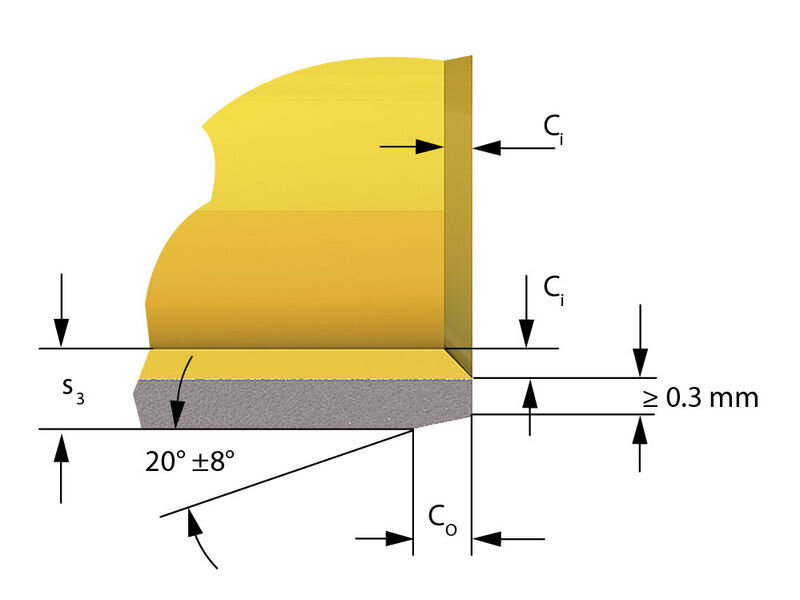
Tab. 5 - Outside bevel Co and inside bevel Ci (Fig. 2) for bushes with metric dimensions to DIN ISO 3 547-1, Table 2
30067
Wall thickness s3 Outside bevel, without cutting Co Inside bevel Ci
    Min. Max.
0.75 0.5 ± 0.3 0.1 0.4
1 0.6 ± 0.4 0.1 0.5
1.5 0.6 ± 0.4 0.1 0.7
2 1.0 ± 0.4 0.1 0.7
2.5 1.2 ± 0.4 0.2 1.0
Tab. 6: Theoretical bearing clearance after press-fitting bushes or flange bushes with metric dimensions, without consideration of possible widening of the bore
30070

Bearing clearance Δs
 

Bush diameter P10, P11, P14, P147*, P180 P20, P200
Di (mm) Do (mm) Δsmin (mm) Δsmax (mm)   Δsmin (mm)  Δsmax (mm)
2 3.5 0 0.054 - -
3 4.5 0 0.054 - -
4 5.5 0 0.056 - -
5 7 0 0.077 - -
6 8 0 0.077 - -
7 9 0.003 0.083    
8 10 0.003 0.086 0.040 0.127
10 12 0.003 0.092 0.040 0.130
12 14 0.006 0.092 0.040 0.135
13 15 0.006 0.092 - -
14 16 0.006 0.092 0.040 0.135
15 17 0.006 0.092 0.040 0.135
16 18 0.006 0.092 0.040 0.135
18 20 0.006 0.095 0.040 0.135
20 23 0.010 0.112 0.050 0.164
22 25 0.010 0.112 0.050 0.164
24 27 0.010 0.112 0.050 0.164
25 28 0.010 0.112 0.050 0.164
28 32 0.010 0.126 0.060 0.188
30 34 0.015 0.126 0.060 0.188
32 36 0.015 0.135 0.060 0.194
35 39 0.015 0.135 0.060 0.194
40 44 0.015 0.135 0.060 0.194
45 50 0.015 0.155 0.080 0.234
50 55 0.015 0.160 0.080 0.239
55 60 0.020 0.170 0.080 0.246
60 65 0.020 0.170 0.080 0.246
65 70 0.020 0.170 - -
70 75 0.020 0.170 0.080 0.246
75 80 0.020 0.170 0.080 0.246
80 85 0.020 0.201 0.100 0.311
85 90 0.020 0.209 - -
90 95 0.020 0.209 0.100 0.319
95 100 0.020 0.209 - -
100 105 0.020 0.209 0.100 0.319
105 110 0.020 0.209 - -
110 115 0.020 0.209 - -
115 120 0.020 0.209 - -
120 125 0.070 0.264 - -
125 130 0.070 0.273 - -
130 135 0.070 0.273 - -
135 140 0.070 0.273 -  
140 145 0.070 0.273 - -
150 155 0.070 0.273 - -
160 165 0.070 0.273 - -
180 185 0.070 0.279 - -
200 205 0.070 0.288 - -
220 225 0.070 0.288 - -
250 255 0.070 0.294 - -
300 305 0.070 0.303 - -
Tab. 7 - Errors, consequences and measures in relation to press fit and bearing clearance at high ambient temperatures, with special housing materials or housing wall thicknesses
Design and environmental influences Consequence Measure Note
Alloy or thin-walled housing Extensive widening
Excessive clearance
Reduce housing bore dG The housing is under greater strain; the permitted housing tension must not be exceeded.
Steel or cast iron housing at high ambient temperatures Smaller clearance Reduce shaft diameter dW by 0.008 mm per 100°C above room temperature  
Bronze or copper alloy housing at high ambient temperatures Poor press fit Reduce housing bore dG, recommended change to diameter per 100°C above room temperature: dG -0.05% Reduce shaft diameter dW by the same value, in order to retain the same bearing clearance.
Aluminium alloy housing at high ambient temperatures Poor press fit Reduce housing bore dG, recommended change to diameter per 100°C above room temperature: dG -0.1% Reduce shaft diameter dW by the same value, in order to retain the same bearing clearance. The housing is under greater strain at temperatures below 0°C; the permitted housing tension must not be exceeded.
Bushes with thicker layer of corrosion protection Outside diameter Do
too large
Insufficient clearance
Enlarge housing bore dG
Example:
Layer thickness 0.015 ± 0.003 mm producing dG +0.03 mm
The bush and housing are subject to greater strain unless appropriate measures are taken.
* On request
All content including pictures and diagrams is subject to change. For assignment and replacement, refer to the current catalogues, TecDoc CD or systems based on TecDoc.