jumpToMain

Moulded parts and sliding elements from PERMAGLIDE®

27319
29752
29755

PERMAGLIDE® plain bearings are made from metal-plastic composite materials. The combination of steel, non-ferrous metals and polymers creates materials with excellent tribological characteristics. The composite, multi-layered materials have a high rigidity and viscosity thanks to the steel back and very good sliding properties thanks to the sliding layer structure of bronze and polymers.

PERMAGLIDE® materials are used to make sheets in thicknesses of 0.5 mm to 3 mm on high-volume machines as primary materials. The sheets can be used to make sliding elements from PERMAGLIDE® in a wide range of designs using all conventional sheet metal processing methods.

The conventional machining options for PERMAGLIDE® materials include
 

  • Cutting blanks, e.g. with a plate shear
  • Drilling and sinking, e.g. mounting holes
  • Nibbling or punching moulded parts
  • Reshaping through bending, edging and deep drawing
  • Rolling large bushes
  • Shaping through water jet cutting or high precision cutting
  • Milling of grooves and recesses


Motorservice offers a wide range of special shapes to suit your requirements, e.g. for machining moulded parts. Machining is carried out according to the high quality standards of the automotive industry with tolerances in accordance with DIN ISO 3547 or more precise. The Motorservice sales team can advise you on the design, material selection and quality of your other designs.

Caution when cutting at high temperatures!


High temperatures cause burns to the cut surfaces. The carbon deposits can be abrasive! Clean the cut surfaces carefully if necessary.

Caution during water jet cutting!


The cutting takes place on the jet side to prevent the sliding layer from being washed away.
Machining the sliding layer
Machining the bearing elements
  • PERMAGLIDE® plain bearings can be cut or can be machined in other ways (e.g. shortening, bending or boring).
  • PERMAGLIDE® plain bearings should preferably be cut from the PTFE side. The burrs produced during cutting would impair the sliding surface.
  • Bearing elements must be cleaned after machining. 
  • Bare steel surfaces (cut edges) must be protected against corrosion with:
    • Oil, or
    • Galvanic protective layers
      • At higher low densities or with longer coating times, the sliding layers must be covered to prevent deposits.

Attention

Machining temperatures that exceed the following limits are hazardous to health:
+280°C for PERMAGLIDE® P1
+140°C for PERMAGLIDE® P2
Chips may contain lead.
Calibrating the bearing bore after mounting

(Only applies to P1 plain bearings)
 

Calibration

PERMAGLIDE® plain bearings are ready to install on delivery, and should only be calibrated if a bearing clearance with a narrower tolerance cannot otherwise be reached.

Attention

Calibration considerably shortens the service life of PERMAGLIDE® P1 bushes.
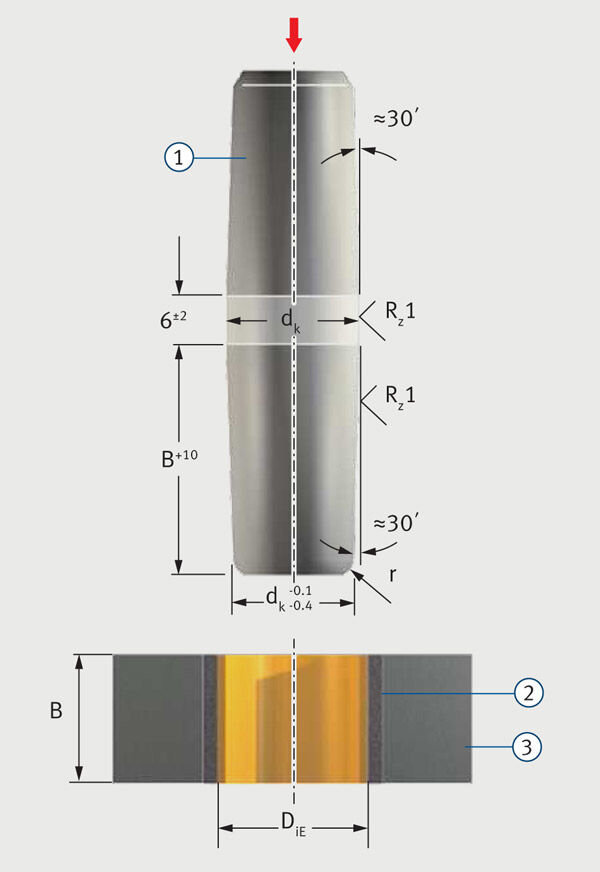
The illustration shows calibration using a mandrel.

The table contains standard values for the diameter of the calibrating mandrel dK. Precise values can only be ascertained through tests.

Better possibilities

The bearing clearance tolerance can be reduced through the following measures, which do not adversely affect service life:
 
  • Narrower tolerances for housing bore
  • Narrower shaft tolerances
29749


1 Calibrating mandrel, case hardening
depth Eht > 0.6, HRC 56 to 64
B Liner length
2 PERMAGLIDE® P10 bush DiE Diameter of the bush in press-it state
3 Housing dK Diameter of the calibrating mandrel
  r Edge, rounded
Desired inside diameter
of the bush
Diameter of calibrating
mandrel1) dK
Service life2)
DiE     - 100 % LN
DiE +0.02 DiE +0.06 80 % LN
DiE +0.03 DiE +0.08 60 % LN
DiE +0.04 DiE +0.10 30 % LN

Standard values for the calibrating mandrel diameter and the reduction in service life

DiE Inside diameter of the bush in press-fit state.
1) Standard value, based on steel housing.
2) Standard value for dry running.